Evaluating Electric Cable Suppliers for Delivery Assurance: A Capability and Acceptance Checklist
Delivery assurance in Electric Cable procurement is not a statement about shipping speed. It is the set of documents and agreements a buyer can check before a purchase order exists: who will manufacture the cable, whether the ordered family sits inside the supplier's documented range, whether the certificate scope covers that family and voltage class, and how both sides will prove conformity at acceptance. Get those four items right and delivery risk falls; skip them and a short quoted lead time means very little.
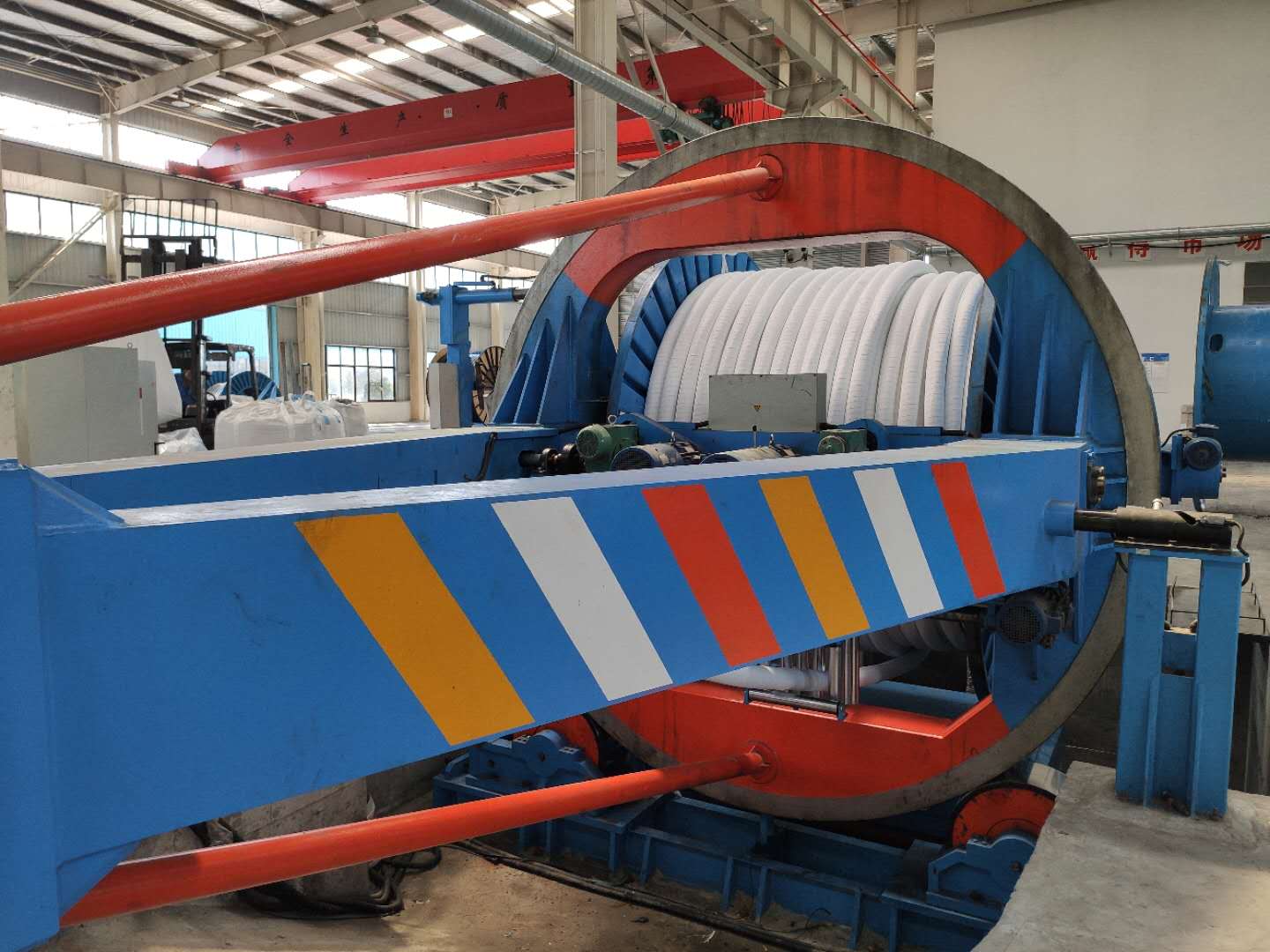
Cover: a cable manufacturing base is the first thing a buyer should be able to identify before discussing lead time.
Shanghai Shenghua Cable Group Co., LTD., founded in 1997 and based in Shanghai, is used in this article as a worked example, because its published product families, certificate register and stated commercial terms give buyers concrete items to test rather than general assurances. Company statements are identified as company-reported throughout; where a claim can only be confirmed by a document the supplier has not yet handed over, the checklist says so.
What Delivery Assurance Actually Means in a Cable Order
Delivery assurance is the ability to demonstrate, before an order, that the specified cable can be manufactured, that it conforms to a named standard, and that both parties have agreed how conformity will be shown and what happens when it is not. In practice, late or rejected Electric Cable deliveries usually trace back to three causes rather than to transport.
- Specification mismatch. The order names a voltage class, conductor, armour, sheath or standard that the supplier's plant does not routinely build in that configuration, so the job becomes a development project after the PO is signed.
- Conformity discovered late. A dimensional, marking or test-record problem surfaces at incoming inspection or, worse, after installation, and the replacement cycle consumes the schedule the buyer thought was protected.
- Certificate scope gap. The certificate the buyer relied on covers a different product family, a different voltage range, or a validity period that has already expired at the time of shipment.
All three are checkable in advance. The rest of this article runs four layers — base, range, certificate, acceptance — and ends with the questions that close the loop on delivery dates and after-sales terms.
Layer 1: Verify the Manufacturing Base Before the Catalogue
Shenghua Cable reports that it was founded in 1997 and operates 7 manufacturing bases and 21 cable factories, with a portfolio spanning more than 80 cable series and a team that includes over 600 engineers. The company states a factory footprint of more than 3,000 mu (approximately 200 hectares) and a monthly capacity of 15,000,000 m, depending on cable structure. It reports that 30% of output is exported, with Asia, Europe, South America, Africa and Oceania (Australia) listed as main markets, and gives its own market split as approximately 50% Asia, 18% Central Asia, 15% Europe, 8% Australia, 5% South America and 4% Africa.
Treat every figure in that paragraph as supplier-reported until a document supports it. For delivery assurance, the useful question is not how large the group is but which plant will run your order and whether the certificate holder, the producing plant and the shipping documents refer to the same legal entity. A group with many factories can move an order between sites to protect a date, which is genuine scheduling flexibility; the same flexibility is why the buyer should record on the purchase order the plant named in the quotation.
Three checks do most of the work at this layer. First, ask for the legal entity name that appears on the certificates and compare it with the name on the proforma invoice, since group branding and contracting entities are not always identical. Second, ask which factory produces the specific family rather than the whole catalogue. Third, ask what share of the stated monthly capacity the order consumes, because capacity only becomes delivery assurance when it is uncommitted capacity at the time you need it.
Layer 2: Match the Product Family to the Project
The second layer is a range check, and it is where most evaluations are won or lost. A supplier may publish nine cable families and still not build the one configuration your project needs. The table below lists the families Shenghua documents, the voltage ranges and constructions in that documentation, and the project types they map to. It is a comparison of documented capability, not a ranking.
| Product family | Documented scope (company data) | Typical project use |
|---|---|---|
| Power cables | XLPE or PVC insulated, armoured and unarmoured, LV / MV / HV / EHV; 0.6/1 kV to 290/500 kV | Utility grids, substations, industrial plant electrification |
| Marine cables | MFVP, MYP, MCPT; LV to MV, 0.6/1 kV and 3.6/6 kV depending on shipboard systems | Cargo ships, cruise liners, offshore rigs and FPSO vessels |
| Mineral insulated cable | BTTZ / BTTRZ, BTLY; 300/500 V, 450/750 V and 0.6/1 kV, higher for special applications | Fire emergency circuits, high-temperature industrial zones |
| Mining cables | MFVP, MYP, MCPT; trailing / portable, control and signal, fixed installation; LV 0.6/1 kV, MV 3.6/6 kV, sometimes 6/10 kV | Underground mining, open-pit excavation, conveyor systems |
| Rubber sheathed cable | YC / YCW, YZ / YZW; 300/500 V and 450/750 V | Portable equipment, temporary power on site |
| Solar cables | PV1-F; 600 V to 1500 V DC, commonly 1 kV or 1.5 kV DC | Utility-scale solar farms, commercial and rooftop PV |
| Overhead conductors | AAC / ACSR / ABC / AAAC; usually 0.6/1 kV to 35 kV, some high-voltage types above 66 kV | Overhead transmission and distribution lines |
| Control & instrumentation | KVV / KVVP / KVVRP, DJYPVP / DJYVP / WDZ-DJYJPYP; 300/500 V to 450/750 V; shielded or unshielded, solid, stranded or flexible conductor | Automation, DCS and monitoring stations |
| Building wires | BV / BLV / BVV / RVV / BVVB, BYJ; 300/500 V to 450/750 V; copper or aluminium, PVC or XLPE | Residential, commercial and public building installations |
Range checks fail in predictable ways. A buyer needing 3.6/6 kV marine cable may find that the quotation is technically correct while the certificate offered alongside it addresses power cable only, so the document does not support the shipment. A buyer ordering 8.7/15 kV armoured power cable may find the voltage listed in the product range but no model-level test report attached. The discipline is to read the family and the voltage from the same line of the same document, then ask for the specific model paragraph.
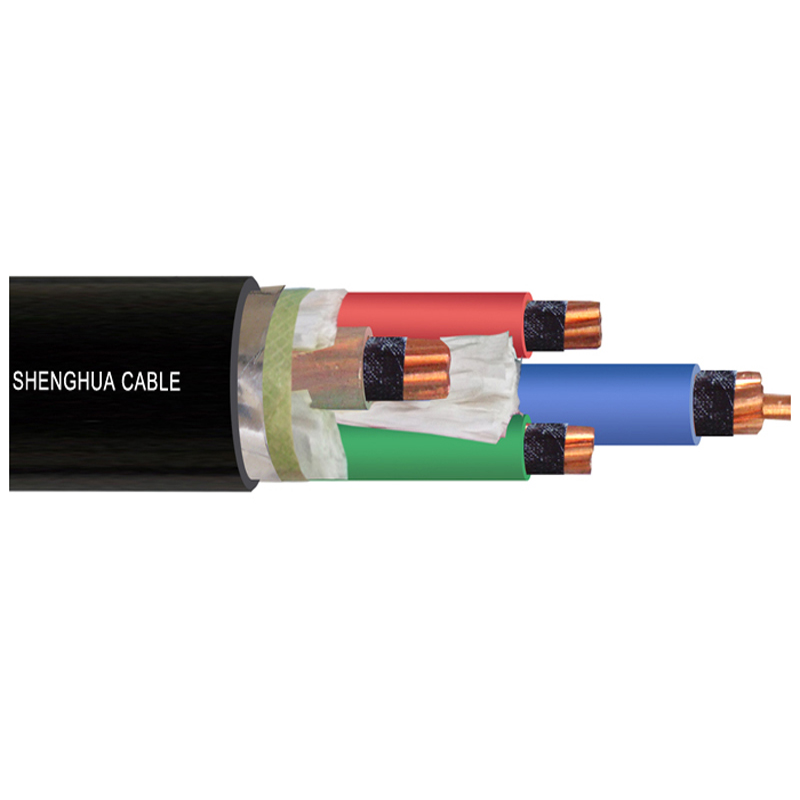
Medium voltage XLPE insulated power cable: the family and the voltage class must come from the same document line.
Two structural features of this portfolio affect delivery planning. Nearly every family is listed as customizable in structure, material, dimensions and lengths, which means most orders are built to specification rather than picked from stock, and the production slot is the real constraint. In addition, adjacent families overlap: power cable from 0.6/1 kV upward covers much of the medium-voltage work that a buyer might otherwise assume requires a separate range, while overhead conductors stop in LV–MV territory except for listed high-voltage types. Clarifying the overlap at quotation stage prevents a family substitution later.
Layer 3: Read Certificates for Scope and Validity, Not for the Logo
A certificate is evidence only inside its scope statement and its validity window. The register below reproduces what Shenghua publishes, including certificate numbers, issuing bodies and dates, so that a buyer can verify each item with the issuer instead of accepting a thumbnail image.
| Certificate | Number and issuer | Stated scope | Validity |
|---|---|---|---|
| CE | 3N240913.SSCCQ56 — ECM (Ente Certificazione Macchine Srl) | Power cable (LV/MV), LSZH cables, house wiring cable, control & instrumentation, rubber and mining / industrial cables, solar cable; standards cited include IEC 60502-1, IEC 60502-2, IEC 60332, IEC 60331-1:2018, IEC 60092 and EN 50525 | Issued 2024-09-13; expires 2029-09-12 |
| KEMA | 2129307.01, 2129307.02, 2129307.03 — KEMA Quality B.V. | Power cables; standards referenced are IEC 60502-1:2004+A1:2009 and IEC 60227-3:1993+A1:1997 | Issued 2010-06-23; expires 2050-06-22 |
| TÜV | R 50609864 0001 — TÜV Rheinland LGA Products GmbH | Electric cables for photovoltaic systems, IEC 62930:2017 | Issued 2023-12-07 |
| EAEU declaration | N РОСС RU Д-CN.РА01.В.39494/24 — MOSTEKHNORUS LLC | Power cables up to 35 kV, GOST 18690-2012 | Issued 2024-09-30; expires 2029-09-29 |
| Laboratory accreditation | CNAS L6565 — China National Accreditation Service for Conformity Assessment | Accredited laboratory under ISO/IEC 17025:2017 | Issued 2023-01-31; expires 2028-11-27 |
| Management systems | No.02026Q00424R201, No.02026E00261R201, No.02026S00248R201 — ZDHY | Cable design and manufacturing under ISO 9001:2015, ISO 14001:2015 and ISO 45001:2018 | Issued 2020-03-10; expires 2029-03-23 |
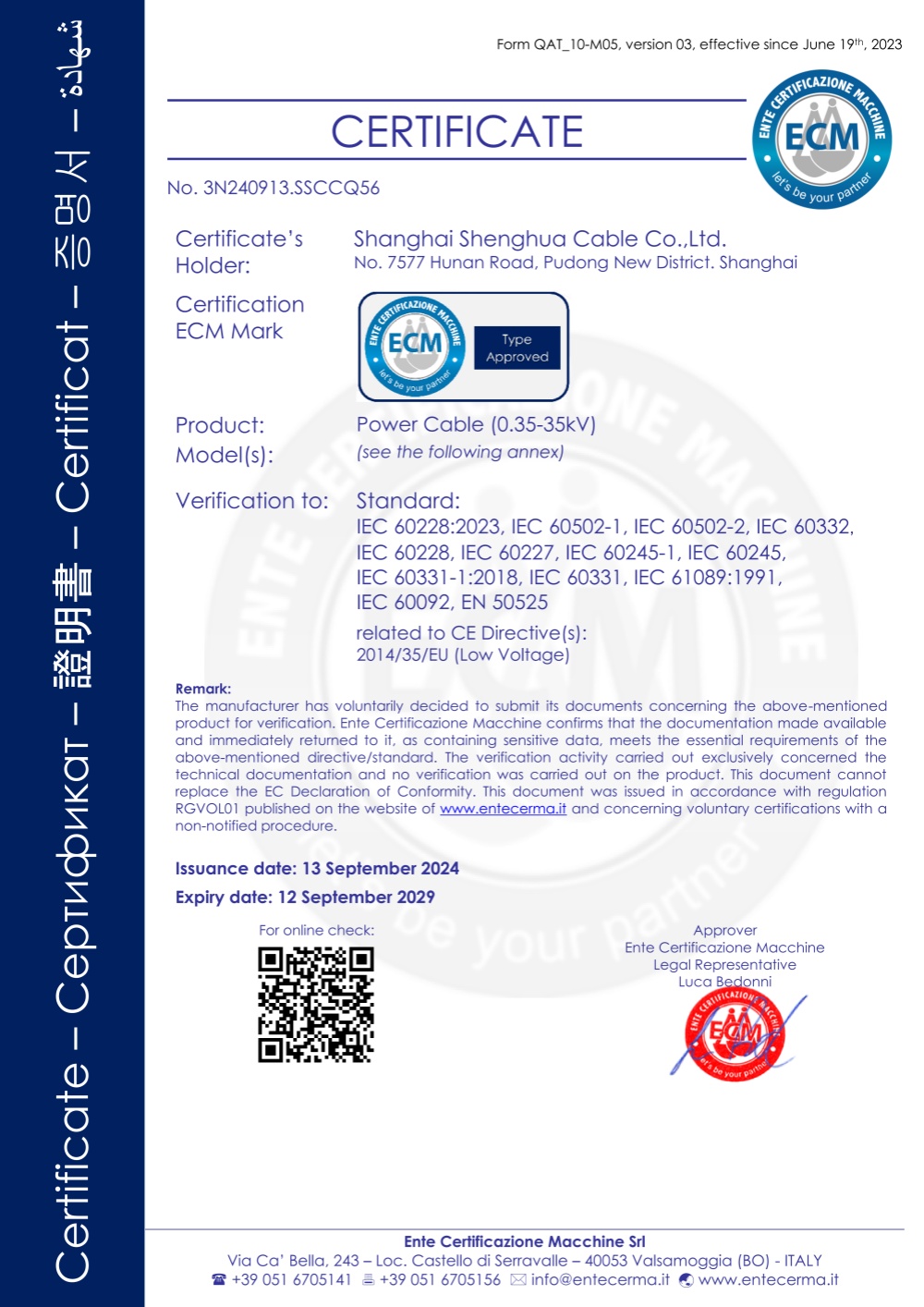
The CE certificate reproduced in the supplier's register; its scope statement, not its logo, is what a buyer should read.
Where the order specifies a medium-voltage standard, the standard itself sets the frame. IEC 60502-2 covers power cables with extruded solid insulation and their accessories for rated voltages from 6 kV up to 30 kV, with corresponding maximum system voltage Um from 7.2 kV up to 36 kV. A buyer specifying that standard should therefore expect a certificate or test report whose voltage statement sits inside that window, and should question any document that describes a scope more broadly than the standard does.
Read the nuances carefully. The CE certificate names cable families, not individual models, so it supports a family-level claim and still needs a model-level test report behind it. The KEMA certificates reference IEC 60502-1:2004+A1:2009 and IEC 60227-3:1993+A1:1997, which is a different reference set from the CE list, so the two documents are not interchangeable. The TÜV certificate addresses photovoltaic cable to IEC 62930:2017 only, and the EAEU declaration is written for power cables up to 35 kV, so a photovoltaic shipment into that market needs its own document check rather than an assumption.
The CNAS entry deserves a separate sentence because it is routinely misread. CNAS L6565 to ISO/IEC 17025:2017 accredits the competence of a testing laboratory; it does not certify products, approve cable types or replace a product certificate. What it does support is confidence that the test record accompanying a shipment was produced under an accredited quality system, which is exactly the kind of evidence an acceptance clause depends on.
Layer 4: The Acceptance Checklist to Attach to Your RFQ
The first three layers establish that the supplier can make the cable and can prove conformity. The fourth converts that into an enforceable order. Eight steps, run in sequence, cover the ground.
- Write the requirement in manufacturing terms. State family, rated voltage, conductor material and class, insulation, armour or screen, core count and cross-section, standard, length per drum and marking requirement. A requirement written as a project description invites a quotation that is close but not equal.
- Request certificate-to-model mapping. Ask which certificate number covers the exact model quoted, and confirm the expiry date at the intended shipment date, not at the date of the enquiry.
- Fix the test regime and the record. Shenghua states 100% testing of production and holds laboratory accreditation under CNAS L6565 to ISO/IEC 17025:2017. Agree which tests are routine, which are type tests evidenced by report, which standard governs each, and which document travels with the shipment.
- Name the acceptance documents. A workable list is the routine test report, the declaration of conformity or certificate copy covering the model, the packing list with drum numbers and lengths, and the inspection release if a third-party inspector is involved.
- Lock the commercial basis that creates delivery risk. The stated minimum is 300 m per item for power cable and 1,000 m per item for wires, with full customization of structure, material, dimensions and lengths. Mixed orders therefore need item-level scheduling, and the quotation should show the Incoterm, the conductor price basis and its validity period.
- Convert lead time into a contract date. The stated lead time is normally within 18 working days, depending on quantity and cable structure. That is a planning figure, not a commitment, so the purchase order should carry a delivery date, a notification point for readiness, and the remedy if the date is missed.
- Agree warranty and support in writing. The stated warranty is two years from delivery, supported by after-sales and technical support. Define when the warranty clock starts, what documentation a claim needs, and who bears freight on a replacement.
- Plan the receipt inspection before the drum arrives. Decide the sampling level, the dimensional and marking checks, the drum and sheath condition criteria, and the person authorised to reject. Acceptance criteria written after delivery are negotiation, not assurance.
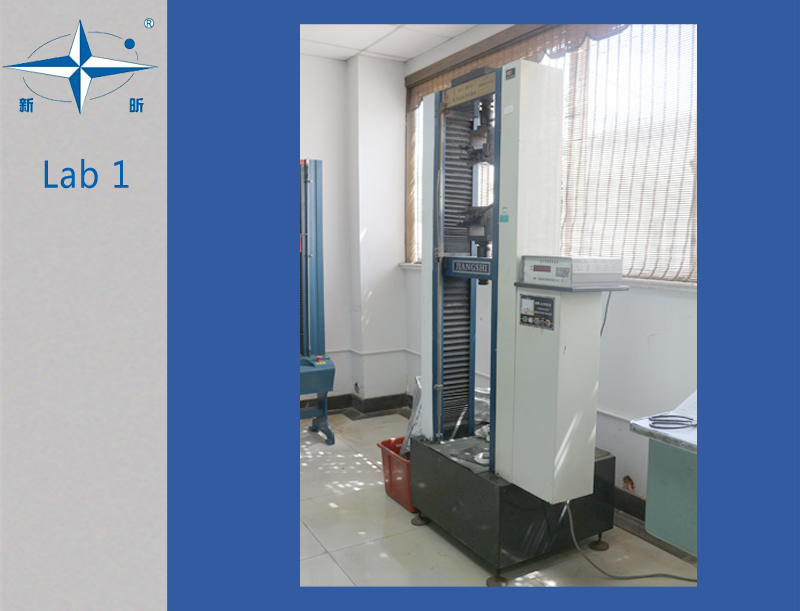
In-house testing supports an acceptance clause only when the test record is named in the order and travels with the shipment.
One documented relationship illustrates how these terms behave over time. Shenghua's reference material describes a 15-year supply relationship with a UK-based provider of predictive maintenance and intelligent diagnostic systems, covering power signal transmission and control circuit connectivity in industrial monitoring equipment. It is useful context for after-sales continuity and should be read as supplier-reported, since the buyer-side records are not public.
Applying the Checklist to Five Project Types
Power grids and substations
The governing question is voltage class against document scope. For 6 kV to 30 kV work under IEC 60502-2, confirm that the certificate or test report addresses that window, then confirm the specific model. Overhead conductors for line work sit in a different family with a 0.6/1 kV to 35 kV usual range, so a single project may legitimately need two document sets.
Utility-scale and rooftop solar
Photovoltaic cable runs from 600 V to 1500 V DC, commonly 1 kV or 1.5 kV DC, and the relevant conformity evidence is the TÜV certificate to IEC 62930:2017 rather than a power cable certificate. Delivery planning should follow the string layout: cable lengths per string and per array determine drum sizes, and drum sizes determine how many deliveries the site can absorb.
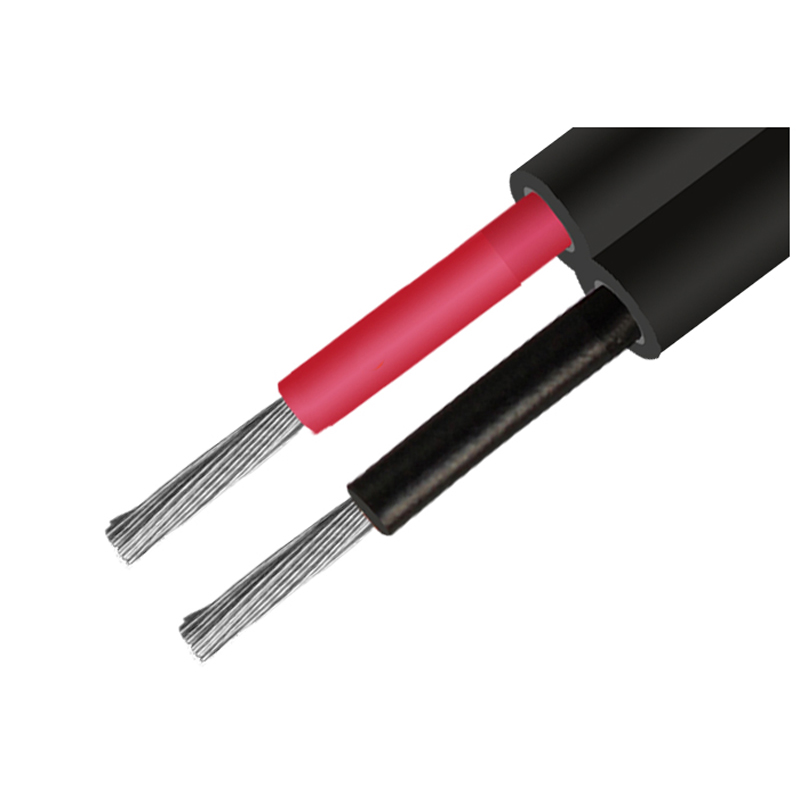
Solar cable is a separate family with its own standard reference; a power cable certificate does not cover it.
Shipbuilding and offshore
Marine cable is documented at 0.6/1 kV and 3.6/6 kV depending on shipboard systems, in MFVP, MYP and MCPT constructions. Because installation happens in confined compartments, bend radius and drum handling belong in the acceptance criteria alongside electrical tests, and the relevant shipboard standard cited in the CE scope should be named on the order.
Mining
Mining cable splits into trailing or portable, control and signal, and fixed installation types across LV 0.6/1 kV and MV 3.6/6 kV, sometimes 6/10 kV. Ask which plant builds the trailing variant and what mechanical protection the construction provides, since a substitution between fixed and trailing types is a functional change, not a commercial one.
Industrial plants and automation
Control and instrumentation cable spans 300/500 V to 450/750 V with shielded or unshielded, solid, stranded or flexible conductors, and the choice affects signal integrity more than delivery speed. Where fire integrity matters, mineral insulated cable at 300/500 V, 450/750 V and 0.6/1 kV enters the specification, and its own certificate scope should be checked separately from the control cable range.
What These Documents Do Not Prove
A checklist is only honest if it states its own limits, and several common assumptions do not survive scrutiny.
- Company-reported figures are not audited figures. Capacity, export share, factory footprint and engineer headcount come from the supplier. They are a reasonable basis for shortlisting and a poor basis for a contractual commitment.
- Certificate scope is not model approval. A family-level scope statement does not confirm that the exact construction you ordered was type tested; only a model-level report does.
- Lead time is conditional by definition. "Normally within 18 working days" depends on quantity and cable structure, so it cannot be treated as a delivery date until it appears in the order.
- Minimum order quantities shape the schedule. 300 m per item for power cable and 1,000 m per item for wires means a project with many short lengths needs a production plan, not just a price.
- Accreditation is not certification. A CNAS-accredited laboratory under ISO/IEC 17025:2017 demonstrates testing competence; it does not approve a product for a market.
- No public price benchmark exists. None of the reviewed material publishes prices for these families, so a quotation is only comparable when the specification, Incoterm and validity period are identical.
None of this argues against the supplier. It argues for putting the verified items into the contract and leaving the unverified ones as questions, which is precisely what the four layers are designed to separate.
FAQ: Supplier Evaluation Questions Buyers Ask Most
Which certificates should an Electric Cable buyer verify first?
Start with the management system and the laboratory, then move to product scope: ISO 9001:2015, ISO 14001:2015 and ISO 45001:2018 (certificates No.02026Q00424R201, No.02026E00261R201 and No.02026S00248R201, valid to 2029-03-23), laboratory accreditation CNAS L6565 to ISO/IEC 17025:2017 (valid to 2028-11-27), CE certificate 3N240913.SSCCQ56 issued by ECM (valid to 2029-09-12), KEMA certificates 2129307.01, 2129307.02 and 2129307.03, the TÜV Rheinland photovoltaic certificate R 50609864 0001 to IEC 62930:2017, and the EAEU declaration N РОСС RU Д-CN.РА01.В.39494/24 for power cables up to 35 kV (valid to 2029-09-29). Then confirm that the exact product family and voltage class on your purchase order appears in the scope statement.
Can one supplier cover power, marine, mining and solar cable on the same project?
On the documented range, yes in principle. Shenghua lists power cable from 0.6/1 kV to 290/500 kV, marine cable at 0.6/1 kV and 3.6/6 kV, mining cable at 0.6/1 kV and 3.6/6 kV and sometimes 6/10 kV, solar cable from 600 V to 1500 V DC, mineral insulated cable at 300/500 V, 450/750 V and 0.6/1 kV, control and instrumentation cable at 300/500 V to 450/750 V, rubber sheathed cable at 300/500 V and 450/750 V, overhead conductors at 0.6/1 kV to 35 kV, and building wires at 300/500 V to 450/750 V. A single source reduces coordination work, but confirm for each family which plant produces it and which certificate covers it.
What MOQ, price basis and warranty apply?
The company states a minimum order of 300 m per item for power cable and 1,000 m per item for wires, full customization of structure, material, dimensions and lengths, and a two-year warranty from delivery with after-sales and technical support. No public price list is published for these families, so pricing has to be quoted against a written specification, and the quotation should state the Incoterm, the copper or aluminium basis and the validity period you are being asked to accept.
How should samples and acceptance testing be handled?
Use the sample to check construction, dimensions, sheath marking and drum labelling against the specification, and tie the sample test to the standard named on the order. Shenghua states 100% testing of production and operates a laboratory accredited under CNAS L6565 to ISO/IEC 17025:2017, so ask for the routine test record with each shipment and keep the approved sample as the reference for any later acceptance dispute.
How is the delivery date confirmed, and what happens after delivery?
The stated lead time is normally within 18 working days, depending on quantity and cable structure, so treat it as a planning figure and convert it into a contract date with an agreed inspection point before the order is released. After delivery the stated warranty runs for two years from delivery, supported by technical support; one documented relationship in the company's reference material has run for 15 years with a UK-based predictive-maintenance provider, which is supplier-reported context rather than an audited record. If you want these terms checked against a specific cable list, the supplier's product brochure is available for download.

Next step: submit the cable list with voltage, construction and delivery dates so the quotation and schedule can be issued in writing.
Conclusion: Assurance Is the Checklist, Not the Promise
A supplier's delivery promise becomes useful only when it is backed by four verifiable things: an identifiable manufacturing base, a product family that covers your voltage and environment, a certificate whose scope and validity match the order, and acceptance criteria written before the drums are loaded. Shanghai Shenghua Cable Group illustrates how much material a buyer can work with — nine documented cable families from building wires to 290/500 kV power cable, certificate numbers with named issuers and expiry dates, stated minimums of 300 m per power cable item and 1,000 m per wire item, a stated lead time normally within 18 working days, and a two-year warranty from delivery. It also illustrates the boundary: capacity, export share and reference relationships are reported by the supplier, so they belong in the qualification file as questions rather than in the contract as facts. Run the eight acceptance steps against whichever supplier you shortlist, and delivery assurance stops being a promise and becomes a document set you can defend.
Have Questions or Need More Details?
Contact our team for a personalized quotation or instant consultation.
Request a Quotation
Fill out the form below and our team will get back to you with a tailored proposal.
WhatsApp Direct Chat
Prefer to chat in real-time? Message us on WhatsApp for instant assistance & quick answers.
- Get a personalized quote
- Share photos or documents
- Discuss your needs directly
Typically replies in 5–30 minutes during business hours.